

Facing a charge of felony grand theft in California is a life-altering event that carries the threat of significant prison time and a permanent criminal record. Under California Penal Code 487, the state distinguishes between minor shoplifting and serious felony offenses based on the value of the property taken. Understanding your rights, the bail process, and your defense options is the first step toward reclaiming your future.
What is Grand Theft Under California Penal Code 487?
In the California legal system, theft is divided into two main categories: Petty Theft and Grand Theft. The primary factor that elevates a crime to “Grand Theft” is the value of the stolen property or the specific type of item involved.
The $950 Threshold: When Theft Becomes a Felony
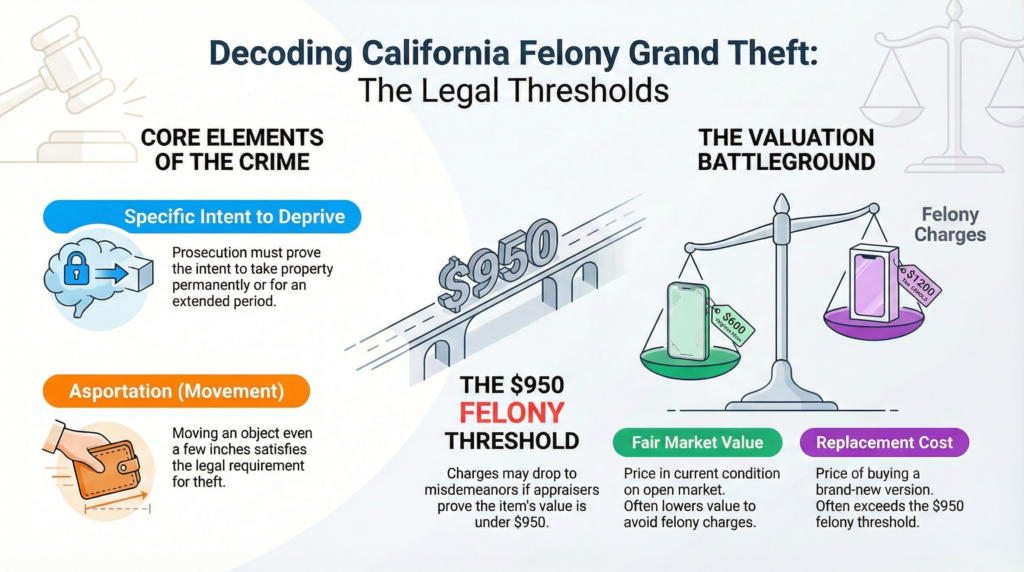
Generally, if the value of the money, labor, or real or personal property taken is exceeding $950, the charge is classified as Grand Theft under PC 487. If the value is $950 or less, it is typically charged as Petty Theft (PC 484), which is a misdemeanor.
Special Categories: Automatic Grand Theft
There are certain instances where the value of the property does not matter. California law dictates that it is automatically Grand Theft if:
- The item is a firearm: Any theft of a gun is a felony.
- The item is an automobile: Known as Grand Theft Auto (PC 487d).
- Direct Theft from a Person: Taking property directly off someone’s body (like pickpocketing or grabbing a purse) is Grand Theft regardless of the dollar amount.
- Specific Crops or Research Animals: Theft of certain agricultural products (like avocados or citrus) or laboratory animals valued over $250.
The 4 Legal Theories Prosecutors Use
A prosecutor can prove you committed grand theft using one of four distinct legal theories. You only need to be found guilty of one:
- Larceny: Physically carrying away someone else’s tangible property with the intent to steal it.
- False Pretenses: Using lies or deceit to convince someone to give you ownership of their property.
- Trickery: Using fraud to get someone to give you possession of property (but not legal ownership).
- Embezzlement: Taking property that was legally entrusted to you (like an employee taking money from a cash register).
New Legal Updates: The Impact of Proposition 36
As of late 2024 and heading into 2025, California’s approach to theft has shifted. While Proposition 47 previously made most thefts under $950 strict misdemeanors, Proposition 36 was introduced to address “smash-and-grab” robberies and repeat offenders. Under these newer rules, if an individual has two or more prior theft-related convictions, a third theft can be charged as a felony, even if the value is well below the $950 threshold. This “three-strikes” style approach for retail theft means that even minor shoplifting can now lead to felony bail amounts and prison sentences for repeat offenders.
Elements of the Crime: What Must be Proven?
To secure a conviction for felony grand theft, the District Attorney must prove specific “elements” beyond a reasonable doubt.
- Specific Intent: The prosecution must prove you intended to deprive the owner of the property permanently or for an extended period. If you took something by accident or truly intended to return it quickly, the “intent to steal” is missing.
- Asportation: This is a legal term meaning the property was moved. Even moving an object a few inches with the intent to steal it can satisfy this requirement.
- Fair Market Value vs. Replacement Cost: One of the biggest points of contention in court is how much the stolen item is worth. California law uses “Fair Market Value”—which is what the item would sell for in its current condition on the open market. This is often much lower than the “Replacement Cost” (the price of buying a brand-new version). Defense attorneys often hire appraisers to prove an item’s value is actually under $950 to get felony charges dropped to misdemeanors.
Penalties and Sentencing for Felony Grand Theft
Grand theft is a “wobbler“ in California. This means the prosecutor has the discretion to charge it as either a misdemeanor or a felony, depending on the circumstances and the defendant’s criminal history.
Felony Punishment
If convicted of felony grand theft, the penalties are severe:
- Jail/Prison Time: 16 months, 2 years, or 3 years in county jail or state prison.
- Fines: Up to $10,000 in addition to restitution (paying the victim back).
- Probation: Up to one year of formal supervision.
Sentencing Enhancements for “Great Takings”
If the theft involves an extremely high dollar amount, the court can add consecutive time to your sentence:
- +1 Year: For theft over $65,000.
- +2 Years: For theft over $200,000.
- +3 Years: For theft over $1.3 million.
Collateral Consequences
The “hidden” costs of a felony conviction often hurt more than the jail time. A felony grand theft conviction is considered a Crime of Moral Turpitude.
- Professional Licenses: Nurses, teachers, real estate agents, and lawyers may lose their licenses.
- Immigration: For non-citizens, a grand theft conviction can trigger deportation or prevent naturalization.
- Civil Rights: You will lose your right to own or possess a firearm for life and may lose your right to vote while incarcerated.
The Bail Process for Felony Grand Theft Charges
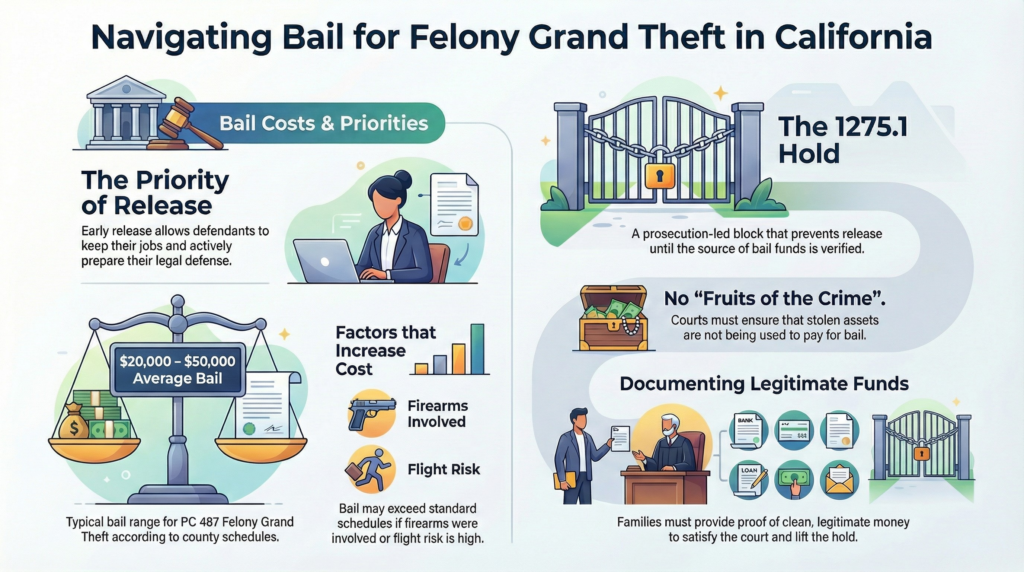
When someone is arrested for a felony, the first priority is getting them out of jail so they can keep their job and prepare their defense.
Understanding Bail Schedules
Each county in California has a “Bail Schedule” that sets a standard price for release. For PC 487 Felony Grand Theft, bail typically ranges from $20,000 to $50,000, though it can go much higher if a firearm was involved or if the defendant is a flight risk.
The 1275.1 Hold
In high-value theft cases, the prosecution may place a “1275.1 hold” on the defendant. This prevents the defendant from being released until they can prove that the money used for bail did not come from the “fruits of the crime.” If you are accused of stealing $100,000, the court wants to make sure you aren’t using that stolen $100,000 to pay for your release. Cali Bail Bonds specializes in helping families navigate 1275 holds by documenting clean, legitimate sources of funds to satisfy the court.
Financing Your Release with Cali Bail Bonds
Most families do not have $20,000 or $50,000 sitting in a bank account. That is where a bail bond company becomes essential. When you work with Cali Bail Bonds, you only pay a small fraction of the total bail amount (usually 10% or less).
0% Interest Financing & Flexible Payment Plans
Cali Bail Bonds understands that an arrest is an unexpected expense. They offer 0% interest financing for those who qualify. This allows you to break the premium into manageable monthly payments. They don’t believe you should stay in jail just because you can’t pay the full amount upfront.
No-Collateral Bail Bonds
In many cases, Cali Bail Bonds can offer “Signature Bonds” or no-collateral bonds. If you have a steady job or a co-signer with a steady job, your “job is your credit.” You won’t necessarily have to put your house or car up as collateral to secure your loved one’s freedom.
24/7 Mobile and Online Bonding
Time is of the essence. Cali Bail Bonds offers a streamlined “Bail-by-Phone” or online process. You can complete all the paperwork from your smartphone without ever having to visit a jail lobby or an office. This ensures the fastest possible release from any California jail.
Legal Defenses to Felony Grand Theft
Just because you were arrested does not mean you will be convicted. Several powerful legal defenses exist:
- Claim of Right: If you had a good-faith belief that the property actually belonged to you, you cannot be guilty of theft.
- Lack of Intent: If you forgot to pay for an item or accidentally walked away with it, you lacked the “specific intent” to steal.
- Owner Consent: If the owner gave you permission to take the property, no theft occurred.
- Civil Compromise : In some misdemeanor-level “wobbler” cases, your attorney can negotiate a “Civil Compromise” (PC 1377). If you pay the victim back in full and they agree not to prosecute, the judge has the power to dismiss the charges entirely.
Life After a Conviction: Can You Clear Your Record?
A felony conviction doesn’t have to be a life sentence.
- PC 17b Reduction: If you successfully complete probation for a “wobbler” offense, you can petition the court to reduce your felony to a misdemeanor.
- Expungement (PC 1203.4): Once your probation is over, you can apply to have your conviction “dismissed.” This can help significantly with background checks for private employment.
People Also Ask (FAQ)
1. How long do I have to stay in jail for grand theft? If you don’t post bail, you may stay in jail until your trial, which can take months. With a bond from Cali Bail Bonds, release usually happens within 2 to 12 hours of the bond being posted.
2. Is grand theft a “Strike” under California’s Three Strikes Law? Generally, grand theft is not a “serious” or “violent” felony that counts as a strike, unless it involved a firearm or was committed in conjunction with a robbery or burglary.
3. What is the difference between Grand Theft and Robbery? Theft is taking property. Robbery is taking property by force or fear. If you take someone’s watch while they aren’t looking, it’s grand theft. If you threaten them to give you the watch, it’s robbery.
4. Can I go to jail for a first-time grand theft charge? Yes, but it is less likely. First-time offenders are often eligible for probation or alternative sentencing, especially if they have a strong legal defense and post bail immediately to show they are responsible.
5. How much does a bail bond cost for a $20,000 grand theft charge? Typically, the cost (premium) is 10%, which would be $2,000. However, Cali Bail Bonds offers discounts for veterans, union members, and those with private counsel, and can set up payment plans as low as 1% down in some cases.
Secure Your Freedom Today
A felony grand theft charge is a serious threat to your liberty, but you don’t have to face it from inside a jail cell. Getting out on bail is the most important step you can take to keep your job, stay with your family, and work closely with your lawyer on a winning defense.
Don’t wait. Contact Cali Bail Bonds right now for a free, confidential consultation. Our agents are standing by 24/7 to help you secure a fast, affordable release.