

If you or a loved one are facing a felony charge in California, you might feel trapped by a high bail amount you simply cannot afford. Fortunately, how to lower your felony bail before trial through AB 321 has become a vital strategy for defendants in 2026. This new law provides a powerful legal path to reduce charges and slash bail costs, and Cali Bail Bonds is here to help you navigate every step of the process.
Understanding AB 321: The 2026 Shift in California Bail Strategy
For decades, California law made it difficult to change a felony charge into a misdemeanor until the very end of a case. However, Assembly Bill 321 (The Better Informed Decisions Act), which went into effect on January 1, 2026, has changed the game for anyone sitting in jail awaiting trial.
What is AB 321 (The “BID” Act)?
AB 321 was designed to give judges more power to make fair decisions early in a case. Before this law, a judge usually had to wait for a preliminary hearing to decide if a “wobbler” (a crime that can be either a felony or a misdemeanor) should be reduced. Now, under the new amendments to Penal Code 17(b), judges can make this change much sooner.
How AB 321 Changes Penal Code 17(b) for Defendants
The most important part of AB 321 is that it allows a court to reduce a felony to a misdemeanor at any time before the trial begins. This means you don’t have to wait months for a specific hearing to ask for mercy. If the facts of your case suggest that a misdemeanor is more appropriate, your lawyer can file an AB 321 motion immediately.
The “Any Time Before Trial” Rule: Why Timing No Longer Blocks You
In the past, many defendants were stuck paying high “felony-level” bail because the legal system moved too slowly. AB 321 removes those roadblocks. By allowing for a reduction earlier in the process, the law helps prevent people from losing their jobs or homes while waiting for a court date that might be months away.
How Bail is Set for Felonies in California
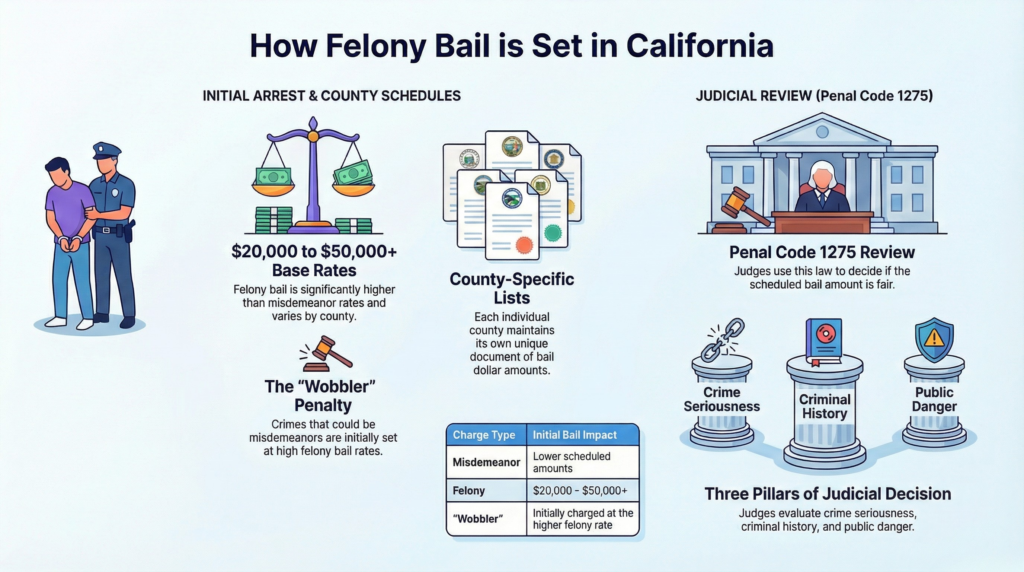
When someone is first arrested, their bail is usually determined by a document called the County Bail Schedule. This is a list of crimes and the dollar amounts required for release.
- The Bail Schedule: Each county (like Los Angeles or Orange County) has its own list. Felony bail is significantly higher than misdemeanor bail, often starting at $20,000 to $50,000 or more.
- Penal Code 1275: Judges use this law to decide if the scheduled bail is fair. They look at the seriousness of the crime, your criminal history, and whether you are a danger to the public.
- The Impact of “Wobblers”: Many crimes, such as certain types of assault or grand theft, are “wobblers.” If you are booked on a felony charge for a wobbler, your initial bail will be set at the high felony rate, even if the case is eventually handled as a misdemeanor.
The AB 321 Strategy: Reducing Your Felony to Slash Bail
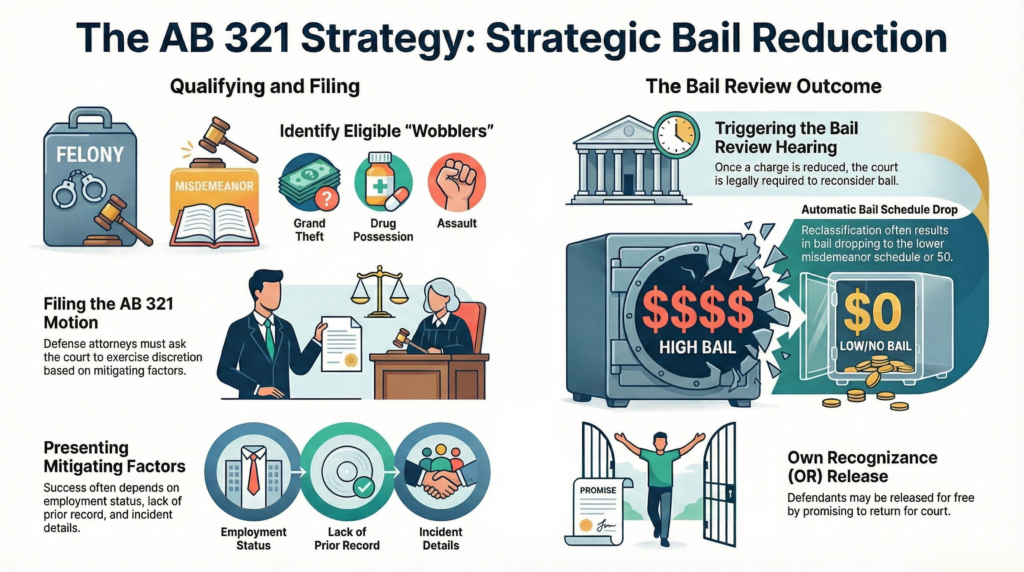
The goal of using AB 321 is simple: if you can convince a judge to re-classify your felony as a misdemeanor, your bail amount should drop automatically to the misdemeanor schedule—which is often much lower or even $0.
Identifying “Wobblers”: Does Your Charge Qualify?
Not every crime can be reduced. “Straight felonies” like murder or rape are not eligible. However, common “wobblers” include:
- Burglary or Grand Theft
- Certain Drug Possession charges
- Assault with a deadly weapon
- Receiving stolen property
Filing an AB 321 Motion for Pre-Trial Reduction
To use this strategy, your defense attorney files a motion asking the court to exercise its discretion under AB 321. They will present “mitigating factors,” such as your lack of a prior record, your employment status, and the specific details of the incident.
How a Misdemeanor Re-Classification Triggers a Bail Review
Once the judge signs an order reducing the charge to a misdemeanor, your attorney will request an immediate Bail Review Hearing. Because the “seriousness of the offense” has legally decreased, the court must reconsider your bail. In many cases, this leads to an Own Recognizance (OR) release, meaning you can go home without paying a cent, as long as you promise to return for court.
Standard Ways to Reduce Bail in California
While AB 321 is a specific tool, there are other traditional ways to lower bail that work alongside it.
- The Humphrey Standard: Based on a landmark California Supreme Court case, judges cannot set bail so high that you cannot afford it unless they prove that no other conditions can keep the public safe.
- Community Ties: Showing the judge that you have lived in the area for a long time, have family nearby, and have a steady job proves you are not a “flight risk.”
- Monitoring Alternatives: Sometimes a judge will lower bail if you agree to wear a GPS ankle monitor or a “SCRAM” device that detects alcohol consumption.
What Happens at a Bail Reduction Hearing?
A bail reduction hearing is a short court session where your freedom is the main topic.
- Defense Argument: Your lawyer explains why the bail should be lowered, often using the new AB 321 guidelines.
- Prosecution Opposition: The District Attorney (DA) may argue that you are a danger or that the crime was too serious for a reduction.
- Judge’s Decision: The judge will either lower the bail, keep it the same, or change the conditions of your release (like requiring check-ins with a probation officer).
Common Challenges and Misconceptions
Even with new laws like AB 321, getting bail lowered isn’t always a “slam dunk.”
What if the AB 321 Motion is Denied?
If the judge denies your motion to reduce the felony, you can’t just keep asking every week. Under the new law, a “renewed motion” can only be made if there are changed circumstances. This usually means new evidence has come to light or your personal situation has changed significantly (like a new medical diagnosis).
Can the DA Block a Bail Reduction?
The prosecutor cannot “veto” the judge’s decision, but they can make it difficult. They may request a PC 1275 Hold. This is a legal move that prevents you from posting bail until you prove the money you are using didn’t come from criminal activity (like drug sales or theft).
Why Choose Cali Bail Bonds for Your AB 321 Case?
Navigating the 2026 legal landscape requires a partner who understands the newest laws. Cali Bail Bonds is more than just a bonding company; we are your advocates during one of the most stressful times of your life.
- 24/7 Statewide Service: Whether you are in Los Angeles, Riverside, or the Bay Area, we are available around the clock to post your bond the moment the judge grants a reduction.
- Flexible Payment Plans: We know that even a “reduced” bail can be a burden. We offer easy, no-interest payment plans that fit your budget.
- Expert Guidance: We work closely with defense attorneys to ensure that as soon as an AB 321 motion is granted, we have the paperwork ready to get you out of jail in hours, not days.
Frequently Asked Questions (People Also Ask)
1. Can I apply for an AB 321 reduction at my first arraignment?
Yes. While AB 321 allows for reductions “any time before trial,” the first appearance (arraignment) is often the best time to start the process. Your lawyer can ask the judge to consider the reduction immediately to avoid high felony bail.
2. How long does the AB 321 process take compared to a standard bail motion?
The timeline is usually the same. Once the motion is filed, a hearing is typically set within 2 to 5 court days. The benefit of AB 321 isn’t necessarily speed, but the fact that it allows the reduction to happen much earlier in the case than it used to.
3. Does reducing my charge for bail purposes affect my final trial?
Yes. If the judge reduces the felony to a misdemeanor under PC 17(b) via an AB 321 motion, the case “shall proceed as if the defendant had been arraigned on a misdemeanor complaint.” This significantly lowers the potential penalties you face if convicted.
4. What are “changed circumstances” for a second motion?
Changed circumstances could include the discovery of new witness testimony, the dismissal of some of your charges, or a change in your health or family situation that makes your presence at home more urgent.
5. Do I still need a bail bond if the charge is reduced?
It depends. If the judge reduces the charge and grants an “OR Release,” you don’t need a bond. However, if the judge simply lowers the bail (for example, from $50,000 to $5,000), you will still need a company like Cali Bail Bonds to post the bond for you.
6. Can AB 321 be used for violent felonies?
Generally, no. AB 321 applies to “wobblers”—crimes that the law allows to be treated as either felonies or misdemeanors. Serious or violent felonies (like PC 211 Robbery) are usually “straight felonies” and do not qualify for this specific reduction.
Contact Cali Bail Bonds Today
Don’t let a high bail amount keep you or your loved one behind bars. With the new 2026 laws like AB 321, there are more ways than ever to secure a fair release. At Cali Bail Bonds, we stay ahead of the law so we can provide you with the fastest, most affordable path home.